About Tigers
Scientific Name: Panthera Tigiris.
Tigers are part of the big cats group, in fact they are the largest of the big cats.They reach maturity about 3-4 years for females, and 4-5 years for males. Tigers have been known to live up to 20 years, especially in captivity.
All tigers are solitary animals, and wander territories, ranging thousands of miles. The Siberian Tigers have the largest territories, ranging around 4,000 miles. The only occasion when tigers are together, is when it is a mother raising her cubs, or a pair of tigers mating. It's important cubs stay with their mothers for about two years, learning the necessary skills about survival before they're on their own. Interestingly, once the cubs grow up, the females tend to find territory close to their mothers, while males are more likely to travel great distances away from the mother. Lastly, tigers are mostly nocturnal.
Below is a video from BBC's, "Spy in the Jungle" documentary about Tigers in the Indian jungle. It's considered a groundbreaking clip, where a mother tigress teaches her cubs how to hunt a Sambar deer.
Below is a also a video from BBC's, "Spy in the Jungle". In this clip you'll see the cubs are older, and becoming more indpendent, before they leave their mother.
Diet
Tigers are carnivores, which means they eat meat. Their diet mainly consists of pigs, deers, rhinos, and elephant calves. Some tigers prey on primates and farmers' livestock when food sources are low.

Offspring
When first born tigers are 2.2 pounds. Usually litters are around 4-5 cubs, but there have been reports of seven. When they are 8 weeks old, they begin to learn to hunt. Once they are 2, they leave on their own.
Size
Tigers range from 200-600 pounds,and 2-4 ft tall, depenending on the species of tiger.If you goto, Species of Tigers page, you can learn more about each species of tiger, their size, and their range in Asia.
Habitat
Tigers only originate on the continent of Asia. They survive in tropical forests, evergreen forests, woodlands, mangrove swamps, grasslands, savannahs and rocky countryside. What's really interesting, on some reserves in India, tigers find shelter in old abandoned temples.
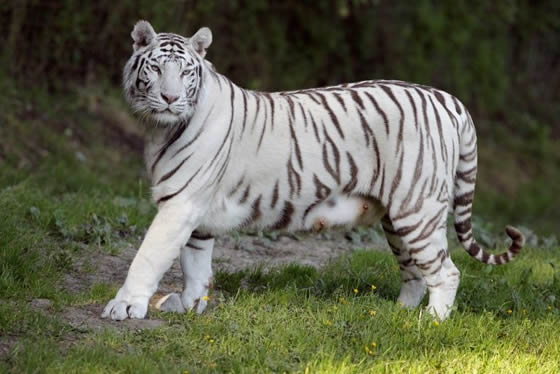
White Tigers
White tigers are tigers that carry the recessive gene for the white pigment of their fur. This is not considered albinism, but interestingly, the gene only runs within the Bengal Tiger family. Because it can be used as a attraction, white tigers are inbred with parents, siblings, and cousins. This causes alot of health issues for the resulting cubs
Characteristics:
Click on the Images to learn a Fun Fact

A tiger’s stripes are unique to each individual, and the stripes travel to their skin. It’s used for camouflage among their environments.

A tiger’s teeth can be anywhere between 2.5 inches-3inches long. Their bite force is around 1,000 lbs per square inch.
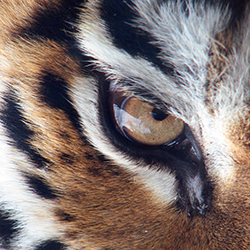
During the day tigers see just as well as we do. But, at night, a tiger can see 6 times greater than a human.

Tiger whiskers are sensory nerves called vibrissae. There are 5 types, helping the tiger with orientation, detecting danger, and knowing when to attack prey.
-
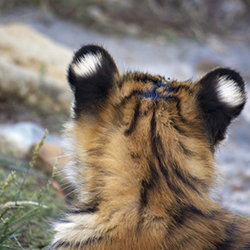
Tigers have a 300-500 Hz, and can hear infrasound. They have white dots on back of their ears, which act like fake eyes.
-
Below is a audio clip of a tiger chuff. Chuffing is used as a greeting amongst tigers.

This is audio clip of a tiger's territorial roar. Other than roaring tigers mark their territory by urinating, scratching and rubbing on trees to distribute their scents.
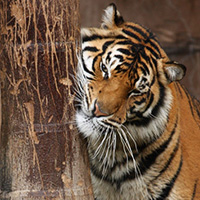
Below is a audio clip of an aggressive roar, used when threatend.